.svg)
Mediation in Practice: Resolving a Commercial Dispute in the Real Estate Sector

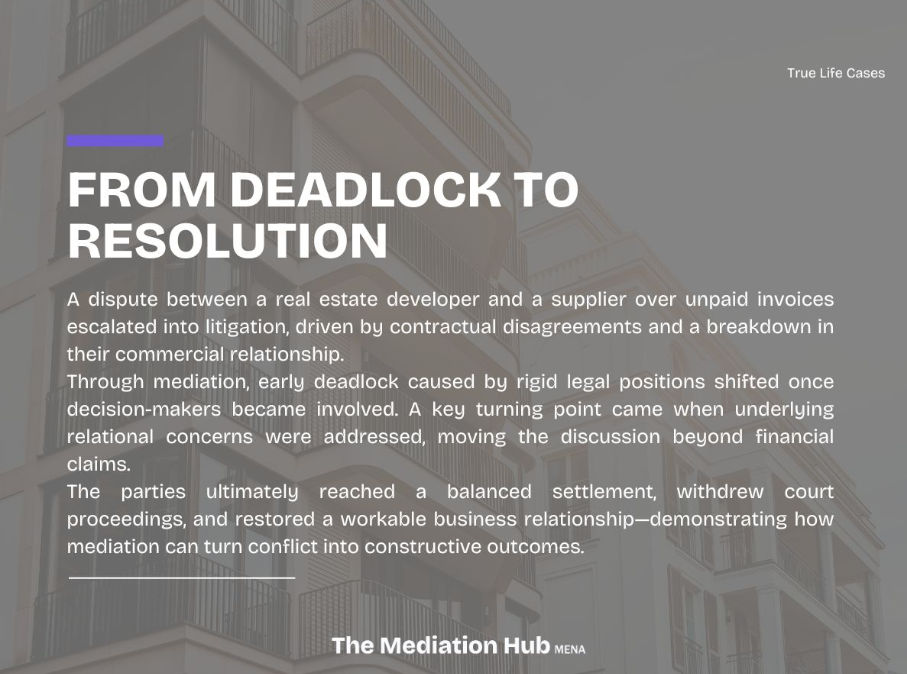
Nature of the Conflict
This matter involved a dispute between a real estate developer and one of its suppliers concerning
alleged unpaid invoices. The dispute had already escalated into formal court proceedings, with both
parties firmly positioned in adversarial roles.
At its core, the disagreement was not limited to the quantum of outstanding payments. It was
compounded by:
differing interpretations of contractual obligations
a breakdown in prior settlement discussions
and a deterioration of the commercial relationship
Importantly, both parties operated within the same sector, and despite the dispute, there remained
potential for future business collaboration, though this was not initially acknowledged.
How the Mediation Process Was Conducted
The mediation was conducted over three structured sessions, each reflecting a shift in dynamics,
participation, and ultimately, progress.
Session 1: Procedural Engagement Without Substantive Movement
The first session was attended primarily by legal representatives:
external counsel for one party
in-house and external counsel for the other
From the outset, it became apparent that one party’s legal representative had little intention of
engaging meaningfully in settlement discussions. This was evident in both joint and private sessions,
where there was:
• minimal willingness to exchange information
• resistance to exploring settlement options
• reliance on rigid, positional arguments
This dynamic persisted notwithstanding that, during the preparation stage, the mediator had
confirmed that all participants held authority to settle. In practice, however, it became clear that
while the representatives possessed formal legal authority (power of attorney), they did not have
the necessary commercial mandate to negotiate and conclude a settlement.
During this session, the defendant advanced a financial offer. However, the decision-making
authority rested with the client, who, when consulted, rejected the proposal outright.
At this stage, the process reached an early impasse.
Recognising this, the mediator identified a critical structural issue:
The absence of the right people, specifically the principals and decision-makers, was preventing any
meaningful progress.
The mediator therefore adopted a strategic intervention:
pausing the process rather than forcing movement
recommending the attendance of principals with full settlement authority
This reflects a core mediation principle:
Bringing the right people into the room is often the single most important factor in unlocking
resolution.
The session was adjourned on that basis.
Session 2: Reframing the Process and Breaking the Impasse
The second session marked a turning point.
The principal attended, accompanied by:
an external lawyer
an interpreter
Following the mediator’s opening, a key process decision was made. The mediator proposed that
discussions proceed in the principal’s native language. This required restructuring the legal team, as
one lawyer did not speak the language and was replaced.
This demonstrated an essential mediation quality:
Flexibility in process design to enable authentic communication.
The session began jointly but quickly revealed significant tension rooted in previous failed
negotiations. The mediator moved to private caucuses to:
de-escalate the situation
allow candid expression
better understand underlying interests
During caucus:
The defendant authorised disclosure of its position and calculations.
The claimant initially rejected this and maintained a litigation stance.
At this point, the mediator applied impasse-breaking strategy, including:
reality testing (time, cost, litigation risk)
encouraging reassessment of records after 18 months of dispute
reframing the discussion from positions to evidence
The claimant agreed to review its position.
In response, the defendant agreed to disclose detailed supporting documentation, thereby
increasing transparency and shifting the discussion from positions and assertions to an evidence-
based dialogue. Notably, this material had previously been withheld for use in litigation, making its
disclosure a significant turning point.
A Critical Breakthrough: Addressing the Real Issue
Before adjourning, the mediator invited final reflections.
This led to a pivotal moment.
The claimant clarified that the core issue extended beyond financial considerations and was rooted
in dissatisfaction with how he had been treated during prior negotiations. This marked a critical
cultural turning point in the mediation.
Cultural considerations in this context went far beyond language alone. While interpretation had
been available, it became evident that personal messages, particularly those carrying emotion,
context, and nuance, are far more effectively expressed in one’s own language. Once the claimant
spoke directly, rather than through an interpreter, the depth of his concerns became fully
understood.
This shift enabled a more authentic exchange. It was at this stage that real understanding began to
emerge, as the parties were able to engage not only with the substance of the dispute, but with the
underlying human and relational dimensions that had previously remained obscured.
The defendant acknowledged this and responded constructively.
This moment:
diffused long-standing tension
rebuilt a degree of trust
shifted the dynamic from adversarial to problem-solving
It also reinforced a key mediation truth:
Disputes are rarely only about money or legal rights, even if that is how they first present.
The parties began to recognise:
their shared industry position
the possibility of future collaboration
Importantly, claimant’s counsel confirmed:
resolving the relational issue was essential for settlement.
The defendant then presented a revised, structured and evidenced offer.
Session 3: Convergence and Resolution
By the third session, the tone had fundamentally shifted.
The parties returned with:
clearer understanding
reduced emotional tension
increased trust in the process
The claimant accepted the defendant’s offer.
The dispute was resolved, and court proceedings were withdrawn.
Key Tools, Strategies and Principles
Several mediation elements proved decisive:
1. Bringing the Right People
Attendance of principals and decision-makers
Ensuring authority to settle
Moving beyond purely legal representation
2. Managing Impasse Strategically
Recognising early deadlock
Pausing rather than forcing progress
Using phased engagement to unlock movement
3. Patience and Process Discipline
Allowing the process to evolve over multiple sessions
Avoiding premature pressure to settle
Trusting that progress is often non-linear
4. Trusting the Mediation Process
Building confidence incrementally
Allowing disclosure at the right time
Creating a safe environment for candid dialogue
5. Flexibility
Adapting language and structure
Adjusting participants
Responding dynamically to party needs
6. Reality Testing
Litigation risk analysis
Time and cost considerations
Evidentiary weaknesses
7. Transparency and Information Exchange
Gradual disclosure of key documents
Moving from assertion to substantiation
8. Addressing Human and Relational Factors
Acknowledging emotional drivers
Repairing communication breakdowns
Reframing the dispute
Outcome and Impact
The mediation resulted in:
a full and final settlement
withdrawal of court proceedings
restoration of a workable commercial relationship
More importantly, it achieved:
a shift from confrontation to collaboration
Practical Takeaway
This case highlights several core lessons for practitioners:
Mediation is not just about settlement, it is about unlocking resolution
Impasses are part of the process, not the end of it
The presence of decision-makers is critical
Patience and trust in the process are essential
Legal disputes often mask relational breakdowns
Cultural awareness can be determinative and, if overlooked, may become a critical barrier to
reaching settlement
Ultimately:
Effective mediation does not force outcomes, it creates the conditions in which resolution becomes
possible.
.svg)
Innovation Hub, Level 1,
Gate Avenue - South Zone
Dubai International Financial Center
Dubai, United Arab Emirates
info@mediationhub.ae