.svg)
Empowering Mediators in the MENA Region
More than a network of mediators, we are catalysts for grassroot change. Our mission is to foster a culture of mediation in the UAE and the broader MENA region to unlock the full potential of mediation, making it a cornerstone of justice and harmony in our region.

Latest News
Presenting the most recent news, developments, and updates in the field of mediation from the MENA region.

The Abu Dhabi Judicial Department (ADJD) has approved 61 private mediators to support the resolution of civil and commercial disputes, reinforcing the emirate’s efforts to promote faster, more flexible, and accessible alternatives to traditional court proceedings.
The newly approved mediators took their legal oath before Counsellor Yousef Saeed Al Abri, Undersecretary of the ADJD, officially authorising them to undertake their responsibilities within Abu Dhabi’s legal framework.
Promoting Efficient and Confidential Dispute Resolution
The initiative aims to provide individuals and businesses with practical alternatives to lengthy court proceedings by facilitating mutually agreed solutions. Private mediation offers parties the opportunity to resolve disputes more efficiently while maintaining confidentiality and reducing potential disruptions to business operations.
Counsellor Al Abri highlighted that the approval forms part of Abu Dhabi’s broader efforts to develop its judicial system and expand alternative dispute resolution mechanisms in line with international standards.
The initiative also reflects the vision of Sheikh Mansour bin Zayed Al Nahyan, Vice President, Deputy Prime Minister, Chairman of the Presidential Court and Chairman of the ADJD, to strengthen the justice system and enhance the delivery of legal services.
Upholding Professional Standards and Fairness
Addressing the newly approved mediators, Al Abri emphasised the importance of integrity, fairness, transparency, and compliance with applicable laws and professional standards. These principles are essential to safeguarding the rights of all parties and maintaining confidence in mediation as a dispute resolution mechanism.
The mediators expressed their appreciation for the trust placed in them and affirmed their commitment to conducting their work independently and impartially, supporting parties in reaching amicable agreements.
Advancing Abu Dhabi’s Dispute Resolution Framework
The approval of the 61 private mediators represents a further step towards strengthening Abu Dhabi’s dispute resolution landscape. By expanding access to mediation, the ADJD seeks to encourage consensual solutions, improve the efficiency of legal services, and support a business environment in which disputes can be addressed without unnecessary delays.
As mediation continues to gain recognition as an effective means of resolving civil and commercial disputes, initiatives of this nature contribute to a broader shift towards collaborative, efficient, and party-centred justice.

Ad Hoc Mediation & Negotiation Competition 2026
The Mediation Hub MENA is pleased to announce its partnership with ADR ODR International for the upcoming Ad Hoc Mediation & Negotiation Competition, taking place in Dubai on 12–13 November 2026.
Designed specifically for law and business students, the competition provides participants with an opportunity to explore the principles and practice of conflict resolution and negotiation in an engaging, international environment.
The competition aims to give students a practical introduction to the ways in which conflicts arise and the different approaches that can be used to address them. Participants will develop an understanding of conflict resolution methods while learning how to critically analyse their application in different situations.
A key focus of the competition is negotiation. Students will be introduced to the fundamental principles behind negotiation and develop basic practical skills to help them navigate conflicts and negotiate effectively. The competition will also explore the importance of cross-cultural awareness, highlighting the challenges and opportunities that can arise when negotiations take place between individuals from different cultural and professional backgrounds.
Beyond developing practical skills, the competition offers students the opportunity to engage with an international community of their peers. Participants will have the chance to meet law and business students from different countries, exchange perspectives, and build connections with others interested in mediation, negotiation, and dispute resolution.
The Ad Hoc Mediation & Negotiation Competition is therefore an opportunity for students to move beyond theoretical learning and gain practical exposure to conflict resolution and negotiation in an international setting.
Who Can Participate?
The competition is designed for law and business students who are interested in developing their knowledge and skills in mediation, negotiation, and conflict resolution.
Participants can register as a team, while professionals with relevant experience may also have the opportunity to participate as judges.
12–13 November 2026
Dubai, UAE
Students, universities, and professionals interested in taking part are invited to register through the competition webpage:
Register as a team or as a judge:
https://www.adrodrinternational.com/negotiation-competition
The Mediation Hub MENA looks forward to welcoming students and professionals from across the region and beyond to Dubai for this international learning and networking opportunity.
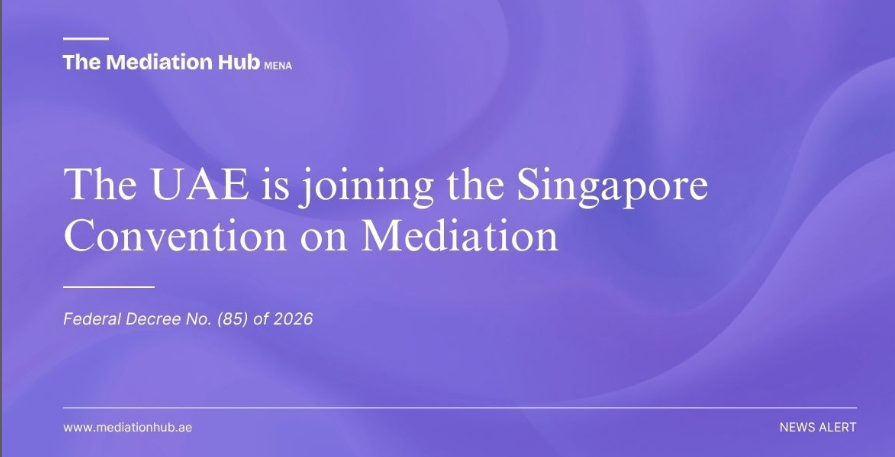
The UAE is joining the Singapore Convention on Mediation.
Federal Decree No. (85) of 2026, issued by President His Highness Sheikh Mohamed bin Zayed Al Nahyan on 8 June 2026 and published in the Official Gazette, formally approves the UAE's accession to the UN Convention on International Settlement Agreements Resulting from Mediation - the Singapore Convention.The UAE is joining the Convention with two permitted reservations: it won't apply to settlement agreements involving the UAE government or its agencies, and it will apply only where the parties to the settlement agreement have agreed to its application.Under the Convention's own terms, it enters into force for the UAE six months after the instrument of accession is deposited with the UN Secretary-General - so the new enforcement regime is coming, but it is not in effect yet.Once in force:
• Where the parties have agreed to the Convention's application, a mediated settlement of an international commercial dispute can be enforced in UAE courts without relitigating the merits or converting it into a judgment or arbitral award, subject to the Convention's limited grounds for refusal
• The Convention applies to settlement agreements concluded after it enters into force for the UAE

ADR ODR International and The Mediation Hub MENA Proudly Enters Into a Strategic MOU to Advance Mediation Across the MENA Region
The Mediation Hub MENA (TMH) is pleased to announce the signing of a Memorandum of Understanding (MOU) with ADR ODR International (AOI), marking a significant step towards strengthening the development, promotion and practice of mediation across the Middle East and North Africa (MENA) region and beyond.The collaboration brings together two organisations committed to advancing mediation through professional development, education, capacity building and practical opportunities for the next generation of dispute resolution professionals.
Under the MOU, members of The Mediation Hub MENA will have access to ADR ODR International’s professional training programmes, international panel and global network, which currently extends across 52 countries and continues to grow. The partnership will also facilitate opportunities for joint programmes, initiatives and ventures aimed at strengthening mediation practice and awareness throughout the region.
Strengthening the ADR ODR International Mediation and Negotiation Competition
A key area of collaboration will be the ADR ODR International Mediation and Negotiation Competition, which has been held in Dubai since 2019. The competition focuses on developing practical mediation and negotiation skills among law and business students and has established itself as a leading competition in the MENA region, as well as one of the top five competitions globally. As part of the collaboration, members of The Mediation Hub MENA will also have the opportunity to apply to serve as judges, further contributing their expertise and experience to the development of emerging mediation professionals.
Leadership Perspectives
Rahim Shamji, Founder and CEO of ADR ODR International, said:
“The collaboration with The Mediation Hub MENA adds to our commitment to promoting mediation within the MENA region. We have seen in such a short time how The Mediation Hub has had an impact on mediation and is fast becoming a lighthouse of high standards, effective dialogue and promotion. We look forward to countless opportunities with them.”
Christine Maksoud and Dr Ahmed Alozn, Co-founders of The Mediation Hub MENA, said:
“Mediation grows one generation at a time. What the region needs is not more talk about mediation but more people who can actually do it, and that is exactly what the competition builds, one student at a time. ADR ODR International has been doing this work in Dubai since 2019; joining forces means we can do it at a different scale. Our members gain a global network; the region gains its next generation of mediators.”
About ADR ODR International
ADR ODR International (AOI) is an international provider of dispute resolution and professional training, specialising in mediation, negotiation, arbitration, conflict management and online dispute resolution (ODR). Founded in 2016 by Barrister and Mediator Rahim Shamji, the organisation was established with a vision of advancing modern mediation and making high-quality dispute resolution education and practice accessible across jurisdictions. With a global network of dispute resolution professionals, AOI works with students, legal and business professionals, universities, institutions and organisations across multiple jurisdictions. Its training portfolio ranges from foundational and advanced mediation programmes to negotiation, arbitration and ODR/AI training, combining practical skills development with international perspectives.
AOI is committed to bridging the gap between traditional face-to-face alternative dispute resolution and the rapidly developing digital world of online dispute resolution. Its programmes emphasise practical learning, professional development and the application of dispute resolution skills in an increasingly international and technology-driven environment. Through its international training programmes, professional networks, competitions and strategic collaborations, ADR ODR International continues to promote the development of the next generation of mediators, negotiators and dispute resolution professionals worldwide.
About The Mediation Hub MENA
The Mediation Hub MENA NPIO (TMH) is a DIFC-based Non-Profit Incorporated Organisation, founded by mediation professionals to cultivate a culture of mediation across the UAE and the broader MENA region. TMH occupies a unique space in the UAE’s legal and dispute resolution landscape: it is the only independent, nonprofit organisation dedicated exclusively to advancing mediation as a mainstream tool for resolving commercial, civil, family business, and community disputes. As mediation gains rapid recognition across the UAE and MENA as a critical enabler of economic competitiveness, TMH was established to provide the connective tissue - standards, advocacy, and ecosystem support - that makes mediation work at scale.
A Shared Commitment to the Future of Mediation
The MOU reflects a shared commitment by ADR ODR International and The Mediation Hub MENA to strengthening mediation as an accessible, practical and effective means of dispute resolution.
By combining international networks, professional education, regional expertise and opportunities for practical engagement, the partnership aims to contribute to the continued growth of mediation across the MENA region while supporting the development of the next generation of mediators and dispute resolution professionals.
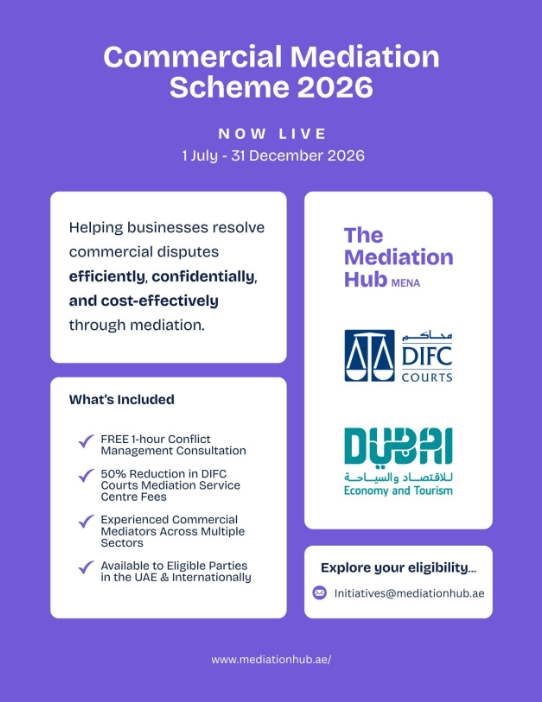
The Commercial Mediation Scheme 2026 is now live.
The Mediation Hub MENA is proud to collaborate with the DIFC Courts and Dubai Department of Economy and Tourism (DET) on a six-month initiative helping businesses resolve commercial disputes quickly, confidentially and cost-effectively — before they escalate into litigation.What's on offer:
🔹 A FREE one-hour conflict management consultation with a Mediation Hub registered mediator for qualifying parties
🔹 50% reduction in DIFC Courts Mediation Service Centre fees for eligible parties who proceed to mediation
🔹 Access to experienced mediators across sectors - construction, logistics, supply contracts, services, trading relationships and more
🔹 Open to eligible commercial parties within the UAE and internationallyWhether it's a payment dispute, rising supply chain costs, contract performance issues or the renegotiation of long-term commercial terms — mediation offers a practical path to settlement while preserving the business relationships you've worked hard to build.
The scheme runs from 1 July to 31 December 2026.Ready to explore whether your dispute qualifies?
📩 Initiatives@mediationhub.ae (subject line: "Commercial Mediation Scheme")
🌐 https://lnkd.in/e-8G68f9
For more info, visit https://lnkd.in/ey8hy8KG
Upcoming Events and Mediation Courses
Featuring events, conferences and mediation training courses.
Latest Publications
Featuring timely topics in mediation from industry leading experts.

A Systemic Analysis, Dogmatic Framework, and Institutional Value of Judicial Referrals to Mediation
The Evolution of the Judicial Function
In contemporary legal and jurisprudential discourse, the role of the magistrate is undergoing a profound and inevitable evolution. The adjudicative function can no longer be confined to a mechanical application of statutory rules to the facts of a case. Within modern legal frameworks, the judge is increasingly defined as the Director of the Proceedings; an authoritative figure equipped with the sensitivity and procedural powers necessary to identify the most appropriate, proportionate, and effective avenue of justice for each specific dispute.
In this light, court-ordered mediation (disposed ex officio or pursuant to statutory discretionary powers) carries a dogmatic and practical significance that far transcends the concept of a mere mandatory pre-litigation procedural condition (condition precedent).
A judicial order directing the parties to mediation based on a reasoned ruling does not constitute a waiver of the potestas iudicandi, nor does it signal a retreat in the face of heavy court dockets. On the contrary, it represents one of the highest, most deliberate, and sophisticated expressions of judicial authority and procedural direction.
1. Judicial Discretion: Dogmatic Criteria and Dispute Anatomy
Why should a judge exercise discretionary power to refer a case to mediation, even in non-mandatory matters or at advanced stages of litigation? The answer lies in the magistrate's ability to perform a diagnostic assessment of the case that extends beyond the formal pleadings (petitum and causa petendi).
The evaluation criteria applied by the judge reflect precise socio-legal considerations and structural dynamics of the dispute:
• Incompressibility of Substantive Interests: In various matters - particularly corporate disputes, long-term performance contracts, property rights, or estate divisions - a judgment strictly declaring rights or awarding damages (operating under a binary "win/lose" framework) is inherently unsuited to realigning the true economic and relational interests of the parties.
• Prevalence of Underlying Relational Dynamics: An experienced judge readily recognizes instances where the formal action represents merely the visible tip of a complex relational conflict. Forcing such disputes into rigid procedural categories often freezes party positions, rendering the continuation of commercial operations or the joint management of assets impossible.
• Effectiveness and Enforceability of the Outcome: The legal system demands not only the issuance of a formal title, but also the guarantee of its long-term stability and enforceability. An agreement tailored by the parties before an accredited mediation body (whether public or private), under the direction and supervision of the court, exhibits a significantly higher rate of voluntary compliance compared to a judicial order obtained after years of adversarial litigation.
2. Institutional and Academic Benefits for the Judiciary
From the perspective of court administration and the standing of the judicial office, the structured and deliberate integration of Court-Annexed Alternative Dispute Resolution (ADR) yields direct, measurable benefits for magistrates.
A. Preserving the Quality of Judicial Reasoning and Elevating the Bench
Overcrowded dockets directly impair the temporal and analytical resources available to the court. Referring disputes characterized by complex factual or commercial negotiations to mediation enables the judge to streamline their active caseload. This allows magistrates to allocate the necessary time and scholarly rigor to drafting well-reasoned judgments for those cases that truly require authoritative judicial determination, legal interpretation, or appellate guidance.
B. Optimizing Court Performance Metrics
From a judicial administration perspective, court-ordered mediation serves as a highly effective management tool. It directly impacts backlog reduction and disposition times, key performance metrics used to evaluate judicial efficiency across international legal frameworks. The judicious application of court-ordered mediation enhances the magistrate's role as a sophisticated manager of justice.
C. Maintaining Judicial Oversight and Reserved Jurisdiction
Referring parties to mediation does not mean delegating the decision-making authority to a third party; rather, it establishes a functional synergy with an external auxiliary mechanism. The judge retains complete governance over the proceedings: scheduling subsequent status hearings, monitoring the outcome of the negotiation, and preserving full jurisdiction to adjudicate the merits should the mediation fail to achieve a settlement.
3. Socio-Legal Impact: Coordinated Justice and Social Cohesion
The impact of judicial discretion in ordering mediation extends directly to the socio-economic framework:
1. For the Litigants: A judicial order encouraging or directing mediation prompts the parties to reclaim autonomy over their dispute. This mitigates the paralysis associated with prolonged litigation, eliminates litigation risk (alea), and preserves commercial or personal continuity.
2. For the Economic System: A system that integrates and values out-of-court dispute resolution lowers indirect litigation costs, enhances market competitiveness, and provides stability in commercial relationships.
3. For Public Institutions: By directing conflicts toward an amicable resolution, the judiciary reaffirms its role not merely as an instrument of adjudication, but as a primary guardian of social cohesion and public order.
Toward a Modern Era of Adjudication
Court-ordered mediation must not be viewed as a compromise or a mere court-clearing expedient. Rather, it represents an evolved, sophisticated, and effective exercise of jurisdiction grounded in principles of proportionality, efficiency, and substantive justice.
By issuing an order for mediation, the magistrate performs an act of true judicial governance: an act that upholds the judge not merely as an arbiter of claims, but as the primary director of balance and social peace within the legal order.
.png)

When Principles Meet Practice: Reflections on IMI’s Draft Mediation Code
Whathappens when a mediator believes they are being impartial, but one party feelsotherwise? Or when a mediatorneeds help to continue a mediation competently, who should agree to that?
These questions stayed with me after attending an IMI mediation meeting atSingapore on 24 August 2026, “Mediation Ethics at the Frontier: EmergingChallenges and Professional Standards”, where practitioners were invited toshare views on the non-binding draft Code of Conduct for Mediators.
It’s worth starting with what “non-binding” means here, because it shapeseverything else. Like the IBA Guidelines on Conflicts of Interest inarbitration, or various UNCITRAL notes, this draft is soft law. It creates nolegal liability and carries no sanctions of its own. Its authority restsentirely on mediators and organizations choosing to be guided by it. That makesprecision matter in a particular way. A binding statute can survive someambiguity because a court will eventually interpret it. A soft law instrumenthas no such backstop. If a term is left vague, it risks meaning somethingslightly different to every mediator who reads it, which undercuts the veryconsistency the Code is trying to build across borders and practice styles.
I want to say upfront that I think IMI’s effort here is worthwhile.Bringing together ethical expectations across such different mediation contextsis not a small undertaking, and inviting practitioners to stress-test the draftis exactly how it gets sharper.
From the discussion at the conference
Two issues came up directly in the room and stayed with me afterwards.
Contingency fees. Practice Rule 1.3.2 prohibits fees contingent on the outcome or amountof the mediated outcome. The room didn’t fully agree on what counts as “contingent”in practice. One challenging question raised was whether such an arrangementmight be the only basis on which some parties would agree to mediate at all.
I understand the underlying concern. A mediator’s financial stake in asettlement could affect, or appear to affect, their independence, and under asoft law framework, appearance carries real weight since there’s no court tolater untangle the reality from the perception. But the rule as written doesn’tmap out its own edges. How should deferred payment or conditional feereductions be treated? What should a mediator say when the parties themselvespropose the arrangement? Their agreement doesn’t resolve the ethical questionon its own, but guidance could at least explain why.
Disciplinary action. The other live issue was less about what the Code prohibits and moreabout what happens when it isn’t followed. Section 3(c) states that failing tomeet the Standards “may be considered within the IMI Professional ConductAssessment Process and result with disciplinary sanctions.” That answerswhether sanctions are possible. It says far less about how they would actuallywork.
Take a hypothetical: a mediator, certified or qualified through IMI andbased in a particular country, is found to have acted unethically. At whatpoint does that conduct cross into something sanctionable? And once it does,what can IMI, an organization with no regulatory authority and no enforcementpower of its own, do about it? Would it write to a bar association or mediationbody in the mediator’s home country? Would it rely on a local organization themediator is affiliated with to take its own action?
This is where the non-binding nature of the Code matters most. IMI isexplicit that the Code creates no legal liability and is not meant to be usedin national disciplinary proceedings unless a national organization voluntarilyadopts it for that purpose (Section 3(d)). That is a sensible limitation for aninstrument with international reach and no power to impose itself otherwise.But it leaves the “disciplinary sanctions” mentioned in Section 3(c) sitting ina kind of institutional grey zone: real enough to be referenced, but dependententirely on the cooperation of bodies IMI doesn’t control. For mediators andparties trying to understand what accountability looks like under this Code,that gap deserves more explanation than the draft currently gives it.
From my own reading of the draft
The rest of these observations developed afterwards, as I sat with thedraft on my own. One of them, the point on capacity below, I also raised thatevening at the networking dinner, in a conversation with IMI’s ExecutiveDirector, who had given the opening speech.
Capacity, described but never defined. General Principle 2.1.1 describes capacity, in thecontext of party self-determination, as the ability to perceive information,understand its meaning, and appreciate its consequences for decision making,extending to the ability to use the relevant technology in online mediation.But a description embedded inside a principle is not the same as a definition.Unlike “Mediation,” “Mediator,’ or “Online mediation,” each of which gets itsown entry in Clause 7, “capacity” never receives a standalone definitionanywhere in the Code.
That gap matters more once you see how the term is used. Practice Rule3.1 states that a mediator “shall terminate the mediation if a party lackscapacity,” making it a trigger for the most serious consequence available underthe Code, without ever pointing back to 2.1.1 or clarifying what standardapplies. So where is a mediator meant to look? A local statute? A professionalstandard from their own jurisdiction? Something else entirely? For a soft lawinstrument with no external authority to eventually settle the question, and nostatute it explicitly defers to, IMI is really the only body positioned todefine the term. Left this open, “capacity” risks being assessed inconsistentlyfrom one mediator, or one country, to the next, which is precisely the outcomea document like this is meant to prevent.
The gap between impartiality and its perception. Practice Rules 1.1.3.2 and 3.3.2address a reasonable person’s concern about partiality when it threatens thestanding of, and public trust in, mediation. General Principle 3.2 alsorecognizes that parties may need different interventions to supportself-determination.
But what should a mediator do when a party says, “You’re taking theirside,” and the mediator genuinely believes they have been impartial throughout?The Code addresses the two extremes: a mediator who knows she cannot beimpartial must withdraw, and a mediator facing a reasonable person’s concernserious enough to jeopardize public trust must also withdraw. What it doesn’taddress is the space in between, the accusation that may or may not meet thatthreshold, where a mediator is left to decide, largely on her own judgment, whetherto explain the intervention, revisit it with the parties, or treat it as asignal that withdrawal is the safer course. Some guidance on that middleground, hearing the concern, examining the intervention, and communicating thereasoning without assuming the accusation itself settles the matter, would helpmediators navigate a moment where their own confidence in their fairness isn’t,on its own, a reliable guide.
Getting help without overstepping. Practice Rule 1.1.1.1 allows a mediator to seek “reasonablyappropriate assistance” when she can no longer continue a mediationcompetently. Asking for help can be responsible practice. But confidentialconsultation with a colleague is a different thing entirely from bringing aco-mediator or specialist into the process itself. An express explanation ofwhen the parties’ informed consent is required for the latter would be useful.
Terminology worth tightening. Finally, the labels deserve attention. The introduction refers to bothIMI Certified and IMI Qualified Mediators. Clause 7(b) defines “mediator”generally, and 7(g) goes on to define IMI Certified Mediators specifically,using “mediator” as shorthand for them throughout the Code. There is nocorresponding definition of IMI Qualified Mediators anywhere in the draft.Defining both designations and being clear about which one a given clause isactually addressing, would make the document considerably easier to follow.
Why these matters
My interest in these details comes from believing in mediation. People bringuncertainty, emotion, and difficult choices into that room. Mediators needspace for professional judgment, and that judgment works best when it’s backedby guidance clear enough to explain, out loud, why a particular call was made.As a piece of soft law, the Code’s real strength will come from howconsistently practitioners can apply it and point to it, not from any authorityit can compel on its own. IMI’s draft offers a valuable foundation. Questionslike these are part of the ordinary, necessary work of turning a good idea intosomething mediators can rely on.


UAE AND THE SINGAPORE CONVENTION ON MEDIATION
Mediation has long offered businesses an attractive proposition: resolve a dispute faster, at lower cost, confidentially and, where possible, without destroying a valuable commercial relationship. Yet one question has continued to concern parties to international transactions: What happens if the other side does not honour the settlement?
That is the problem the United Nations Convention on International Settlement Agreements Resulting from Mediation—the Singapore Convention on Mediation—was designed to address. For the UAE, the move towards accession is therefore more than another development in dispute resolution. It complements the country's ambition to provide international businesses with a sophisticated, predictable and modern legal environment for resolving disputes.
Why Was the Convention Needed? International arbitration has long benefited from the 1958 New York Convention, which provides a widely accepted framework for the recognition and enforcement of foreign arbitral awards. Mediation did not have an equivalent. A mediated settlement is essentially an agreement voluntarily reached between parties. If one party subsequently refused to perform, the other could face the prospect of commencing proceedings based on breach of that settlement.
The Singapore Convention seeks to address this weakness. Adopted by the United Nations General Assembly in December 2018 and opened for signature in Singapore on 7 August 2019, it establishes an international framework through which qualifying commercial settlement agreements resulting from mediation can be relied upon and enforced across borders. Put simply, it seeks to give international mediated settlements something they have historically lacked: greater enforceability and predictability.
Where Does the UAE Stand? The UAE announced its intention to join the Singapore Convention in March 2022. A significant step followed in 2026 with Federal Decree No. 85 of 2026, approving the UAE's accession to the Convention. Domestic approval does not mean the Convention is already operational in the UAE. Under Article 14, the Convention enters into force for a state six months after its instrument of accession is deposited with the Secretary-General of the United Nations. Until the UAE completes that process and the prescribed period has elapsed, the Convention's enforcement framework will not apply in the UAE. So businesses should not yet treat the new enforcement mechanism as available.
The UAE has chosen to make use of both reservations permitted under Article 8. First, the Convention will not apply to settlement agreements involving the UAE government, governmental agencies or persons acting on their behalf. Second, and particularly important for businesses, the UAE has adopted the opt-in reservation. The Convention will therefore apply only where the parties have expressly agreed to its application.
Once the Convention becomes effective for the UAE, lawyers drafting international mediated settlements should specifically consider whether their clients want its protection. If they do, the agreement should expressly record the parties' agreement to the application of the Convention. A few carefully drafted words could determine whether an international enforcement mechanism is available. What Does It Mean for Business? Consider a UAE company involved in a substantial dispute with an overseas supplier. The parties mediate, reach a settlement, preserve their commercial relationship and avoid costly proceedings. Then one party fails to perform. The Convention is intended to strengthen that position. Once applicable in the UAE, a party to a qualifying international commercial mediated settlement—where the UAE's opt-in requirement has been satisfied—will be able to seek relief under the Convention in accordance with applicable procedural rules, without first having to obtain a judgment on the settlement or convert it into an arbitral award.
That changes the commercial calculation. The question is no longer simply, "Can we settle?" It also becomes, "If we settle, can we rely upon it internationally?"
Greater confidence in the answer may encourage businesses to mediate earlier, rather than treating mediation as a final attempt after lengthy litigation or arbitration. A valuable alternative. Mediation is often promoted because it can save time and money. But that undersells its real value. Its greatest strength may be flexibility. A court or tribunal generally determines legal rights and remedies. Mediation allows parties to explore solutions that a court may never be able to order. Payment schedules can be renegotiated. Commercial arrangements can be restructured. Future business can be preserved. Confidentiality can be protected. Parties can devise solutions reflecting commercial realities rather than simply legal entitlements.
This is particularly valuable in the UAE, where business relationships frequently cross jurisdictions, cultures and legal systems. A dispute does not always need a winner and a loser. Sometimes the best result allows both sides to move forward. The move towards the Convention is part of a larger story. Over the past two decades, the UAE has developed sophisticated dispute resolution infrastructure. The DIFC Courts, ADGM Courts, arbitration institutions and increasing emphasis on mediation have helped establish the country as an international dispute resolution hub.
The Singapore Convention adds another dimension. Legal certainty matters to investors. Businesses want to know not only what happens when transactions succeed, but what happens when they go wrong. A jurisdiction offering credible litigation, arbitration and mediation mechanisms give businesses meaningful choices. The Convention could also stimulate mediation as a profession in the UAE. Greater confidence in mediated settlements should increase demand for qualified mediators, mediation centres and lawyers skilled in mediation advocacy. Lawyers may also need to adjust their approach. Effective mediation advocacy is not simply litigation conducted around a conference table. It requires understanding interests as well as rights, identifying commercially acceptable outcomes and recognizing when compromise creates greater value than victory. The Convention should not be overstated. It contains grounds on which relief may be refused, including incapacity, issues concerning the validity or binding nature of a settlement, certain serious breaches of mediator standards and public policy considerations.
The UAE's opt-in reservation also means the Convention will not automatically apply to every mediated settlement. Parties must consciously choose it. There is also a emporal limitation. Under Article 9, the Convention applies only to settlement agreements concluded after it enters into force for the relevant Convention Party. Existing settlements will therefore not suddenly acquire Convention protection. These limitations do not diminish its importance. They demonstrate why effective dispute resolution depends not merely on treaties, but also on good drafting, informed lawyers, competent mediators and consistent judicial implementation.
Perhaps the Convention's has been convincing them that mediation offers sufficient certainty when substantial international interests are at stake. A credible cross-border enforcement framework changes that conversation. For the UAE, the development fits naturally with its position as a centre for international trade, investment and dispute resolution. Accession will broaden the options available to international businesses and reinforce the country's commitment to modern commercial dispute resolution.
The real success of the Convention, however, will not be measured by how many lawyers cite it. It will be measured by how many disputes never reach a courtroom or arbitral tribunal because businesses have sufficient confidence to sit across a table, negotiate and compromise—and know that the agreement they sign carries international weight.
Mediation has always offered the possibility of settlement. The Singapore Convention offers something more important: greater confidence in that settlement. And in international commerce, confidence can make all the difference.


One Dispute, Several Forums Why mediation might be the only process built to see the whole picture
A client of mine once received a cease-and-desist letter over a domain name he had registered more than ten years earlier. The company sending it was a multinational that had only started using a similar trade name in the last five years, but they wanted the domain, and they wanted it now.
My client wasn’t even using the domain actively. Still, the decision wasn’t as simple as it sounds, giving something up rarely is. We went through it properly: what it cost to hold onto each year, what value it was realistically adding to the business, what the future looked like with it and without it, and what a trademark fight across two jurisdictions would cost in time, legal fees and distraction. Once we laid the real choice out plainly, the answer became obvious to him. He agreed to transfer the domain and moved on. One honest conversation. No months of litigation, no filings in two countries, no years of uncertainty hanging over the business.
It never went to formal mediation, we settled it before that stage, but I think about that case often, because it captures what mediation does at a larger scale: it lets people step back from the fight in front of them and look at the whole problem, not just their slice of it. That’s rarely how cross-border disputes actually unfold. Take a joint venture set up in the UAE, with shareholders from three different countries. The shareholders’ agreement says arbitration. The loan documents point to a national court. A guarantee sits under a different law entirely. The moment the relationship breaks down, one shareholder starts arbitration, another rushes to court for a freezing order, the lender begins enforcing its security, and someone is quietly considering insolvency.
Every one of those steps might be necessary. But none of the people deciding them can see the whole picture. The arbitrator can only rule on what the shareholders agreed to arbitrate. The judge granting the freezing order isn’t deciding who owes what. The insolvency court is sorting out who gets paid first, not whether the business relationship can survive. The company ends up fighting on four fronts while the actual commercial problem, the one that started all of this, is still sitting there, unresolved.
This is where mediation does something genuinely different. Court and arbitration remain the right tools when someone needs urgent protection, or a binding decision handed down, mediation isn’t trying to replace that. What it offers instead is the ability to bring everyone into one room, something no single case ever could. Shareholders, the company, the bank, a guarantor, an insurer, sometimes even a board member who has never appeared in the filings, can all sit down together. And because the outcome depends on the parties agreeing rather than a ruling being imposed on them, the solution does not have to look anything like a judgment. It can be a payment plan, fresh security, revised delivery terms, a transfer of shares, a restructured relationship going forward, or a coordinated way to wind down proceedings running in more than one country at once. Mediation can’t bind anyone who is not in the room, but everyone who is can build something far wider than any single tribunal could deliver.
Timing matters more than people expect. It’s rarely useful to mediate on day one, a party often needs to understand the numbers first, take advice, or secure its position before it can negotiate from strength rather than fear. The better moments tend to arrive once the pleadings have clarified what’s genuinely in dispute, once an urgent order has stabilised the situation, before a hearing that will be expensive no matter who wins, or while an award is being challenged or enforced. None of this means the formal case has to stop in the meantime. Deadlines and rights can be protected through a standstill agreement or a short pause, while the real conversation happens alongside.
Getting the right people into the room matters just as much. A deal is only as good as the authority behind it, lawyers for the named parties may not be enough; a parent company, a lender, an insurer, or an insolvency officer might need to be there too. Even then, someone may be able to negotiate but not sign off on releasing security or transferring an asset. It’s worth finding out who can approve what before the mediation starts, not after everyone thinks a deal has been struck. Even a good settlement can fall apart later if it doesn’t travel well. It has to work in every jurisdiction where the case, the parties, or the assets sit, which law governs it, how payments and releases are sequenced, how each pending case gets closed or stayed, what happens to existing court orders, whether regulatory or tax approvals are needed, and where it might eventually need to be enforced. Skip that groundwork, and a poorly built settlement can quietly turn into the next cross-border dispute. Courts and tribunals decide only the case placed in front of them, nothing more. In a conflict spread across borders, that can mean several rulings that still leave the real dispute standing. Mediation is often the one place where everyone who actually matters can step outside their individual case files and agree on a single outcome that holds together, across contracts, proceedings and borders.
None of this happens by accident. Mediation itself is not new to the region, but the infrastructure that makes it work at scale, panels of qualified mediators, dedicated mediation centres, formal partnerships between mediation bodies and the courts, is a much more recent addition. Organisations like The Mediation Hub MENA exist for this: connecting businesses to qualified mediators, working with courts such as the DIFC Courts and ADGM Courts to make mediation a genuine first step rather than an afterthought, and, through a new partnership with ADR ODR International announced in August 2026, giving its members access to a global mediator network and training spanning more than fifty countries, exactly the kind of reach a dispute crossing borders actually needs. As the region moves toward ‘mediation before litigation’ as a starting principle, businesses caught in fragmented, multi-forum disputes like the one described above will have a real, accessible place to turn before the fight spreads any further.

"When I Retire, I'll Become a Mediator": Deconstructing a Persistent Myth
Adapted andtranslated from the original French article « À la retraite, je serai médiateur» : un mythe à déconstruire. Published on https://www.actu-juridique.fr/marl/a-la-retraite-je-serai-mediateur-un-mythe-a-deconstruire/and co-written with Elsa Costa, Mediator.
A tenacious idea circulates in professional circles,particularly among lawyers, judges and senior executives approaching the end oftheir careers: that mediation offers a natural, gentle landing — a way to stayintellectually active, put decades of experience to use, and render a serviceto society, all without the pressures of litigation or corporate life. Thisvision presents mediation as a second professional life accessible withoutgenuine preparation or personal transformation. It is a myth, and its effectsare far from harmless. This article, focused on generalist mediation (excludingthe distinct fields of family and social mediation), examines where thisreductive representation comes from and why mediation now demands fullrecognition as an autonomous profession.
How the myth took hold
A simplifying social perception
Mediation is sometimes called "the oldest profession in the world," rooted in ancestral practices of dialogue: Socratic maieuticsin ancient Greece, the African art of the palabre, Confucian traditions in Asia, healing circles among the indigenous peoples of North America and Oceania. These origins testify to a universal aspiration to resolve conflictpeacefully — but they have also shaped an image of mediation as a peacefulinterlude, the opposite of the pressure and stress that make up a courtroom'sexperience.
The philosophy of mediation reinforces this impression. It privileges cooperation, flexibility and inventiveness over the adversariallogic of victory in court. The mediator has no power or willingness to impose a decision; the parties negotiate and craft their own agreement. Yet these principles, far from indicating a lack of rigour, reflect a differentconception of normativity — one grounded not in the authority of the State or an arbitrator, but in party autonomy in pursuit of an amicable resolution. Thewidespread belief that mediation demands little emotional or intellectual investment, and that agreements emerge through polite conversation and commonsense alone, profoundly misreads the discipline.
Institutional discourse and the trap of "free" mediation
Public institutions have compounded the problem. Across regional authorities, national employment agencies and even the French Ministry of Justice, official communications consistently promote free access to mediation as its principal selling point. The intention — removing financial barriers between institutions and dissatisfied users — is legitimate. But the framing is misleading: "free" mediators are in fact remunerated by the commissioning institution, ultimately by the taxpayer. Worse, the rhetoricof gratuity instils in the public mind the notion that a mediator's work has no market value, quietly devaluing the entire activity.
An economic reality that feeds the myth
The belief that "you cannot make a living from mediation" is largely self-sustaining. Hundreds of newly trained mediatorsenter the market each year around the world. According to a study conducted in the United States, roughly 80% of trained mediators do not earn enough from mediation and must maintain another professional activity in parallel. Only about 5% of the most recognized mediators receive enough cases to generate comfortable revenue, in a strongly polarised, winner-takes-all market. Another analysis, published in 2018, estimated that 90% of the work goes to 10% of mediators — and that within that group, only 1% earn incomes comparable tothose of lawyers.
The consequence is circular: many practitioners treat mediation as a retirement supplement, which distorts the market to the detriment of full-time mediators and locks the profession into an economic model reserved for those who no longer need to earn a living from it.
Yet the potential demand is immense. In France alone, courtshanded down over 1.9 million civil and commercial decisions in 2024, alongsidenearly 300,000 administrative cases — with ever-lengthening delays. If evenhalf of these disputes were channelled towards amicable resolution, tens ofthousands of mediators would be needed. The shortage of cases is therefore lessa question of demand than of the absence of institutional mechanisms allowinglarge-scale professional deployment. Mediation remains confined to the marginsor mobilised too late, when it could operate systematically from the firstsigns of tension — and even upstream, through project and preventive mediation.
The confusion of dual roles
Advertising oneself simultaneously as a lawyer and a mediator, or as an HR director and a mediator, risks confusing the very peopleinvited to a mediation. These roles rest on fundamentally different postures. The lawyer analyses, qualifies, advises, builds strategy and argues to win — apartisan, results-oriented stance. The mediator, by contrast, is a neutral, impartial and independent third party whose task is to create a secure space for dialogue, foster mutual understanding, and accompany the parties towards a solution they build themselves — never advising, never deciding, always equidistant. The mediator draws on skills largely foreign to legal reasoning: relationaldynamics, active listening, emotional regulation, negotiation facilitation, informed by psychology, non-violent communication and behavioural economics.
Moving from advocacy to mediation is not a lateral step but a genuine paradigm shift, both professional and personal. Practice confirms the difficulty: in court-ordered mediations, parties and their counsel frequently struggle to abandon adversarial reflexes in favor of collaboration and co-construction.
Towards a fully-fledged profession
Strengthening the regulatory framework
The absence of mandatory certification encourages candidates to enter the field with excessive optimism and little awareness of its realdemands. In France, the National Mediation Council (Conseil national de la médiation, CNM), created by law in 2021 and installed in 2023, marks a majorprogress: it is tasked with proposing a code of ethics, establishing national standards for training and certification, and harmonising practice. But as apurely consultative body, it holds no regulatory or disciplinary power. Quality remains fragile without binding standards, evaluation mechanisms and sanctionsfor ethical breaches. The next step is either an evolution of the CNM or thecreation of a dedicated body with powers of accreditation, oversight and discipline — on the model of Belgium's Federal Mediation Commission. Such areform would serve a dual purpose: genuine professional recognition for mediators, and effective guarantees of competence and probity for the public.
A regulated profession — without losing mediation'ssoul
Mediation already qualifies, in France, as a liberal profession; it is not yet a regulated one, whose access and practice are conditioned by law on specific qualifications. Regulation would guarantee high standards and credibility, though it carries risks of rigidity and uniformity. The example of psychologists in France shows that regulation need not mean a professional order: registration with public authorities or national registers offers a lighter alternative, capable of preserving the creativity, autonomy and flexibility at the heart of mediation. Regulation would also require careful treatment of dual practice with other regulated professions, within compatibility regimes and conflict-of-interest safeguards comparable to thosealready in place with other professions.
A profession to be relearned
Modern mediation emerged in structured form in the United States in the 1970s under the ADR banner, propelled by the Harvard NegotiationProject (1979) and the Program on Negotiation (1983), before spreading to Europe in the 1980s and 1990s. Today's mediator must master negotiationfundamentals, the psychology of individuals in conflict, and the decision-making processes of the organizations concerned. Basic training courses — 30 to 40 hours in the United States, up to 200 hours in France — areonly a minimal foundation. True professionalization rests on advanced study, recognised certification and, above all, regular practice sustained by peerintervision and reflective analysis. Former lawyers, judges, executives and HR professionals must fundamentally rethink their relationship to conflict:mediation's posture, ethics and skills derive neither from managementexperience nor from legal practice, however prestigious.
Building a new reputation
Finally, a reputation earned in litigation or corporate leadership does not transfer automatically. A name built on combativeness or the intransigent defence of client interests can even prove counterproductive in a practice founded on trust, listening and neutrality. Establishing oneself as a mediator means patiently building relationships with judges, lawyers and business leaders, speaking at conferences, publishing, and obtaining recognized certifications — a long-term, total commitment.
Conclusion
Mediation must no longer be imagined as an undemanding pastime for the end of a career, but recognized as a rigorous discipline withits own skills, ethics and professional identity. Its potential is immense; for now, success is assured only to a minority. The keys are competence, specialisation — and the willingness to devote oneself to mediation fully, not incidentally.

Get Involved
The Mediation Hub offers various ways to actively engage and contribute to our mission.
Mediation Initiatives
Mediation initiatives will be launched soon. Stay tuned!


Professional development
If you are a mediator or a mediation advocate, and you wish to develop your skills and capabilities, discover training, courses, webinars and other materials from international experts and organizations.
Resources
Learn about mediation laws and regulations in the various countries in the MENA region

Get in touch
Any question or remarks? Just write us a message!
.svg)
Innovation Hub, Level 1,
Gate Avenue - South Zone
Dubai International Financial Center
Dubai, United Arab Emirates
info@mediationhub.ae