.svg)
The Private International Law of Commercial Mediation By Dr. Haris Meidanis

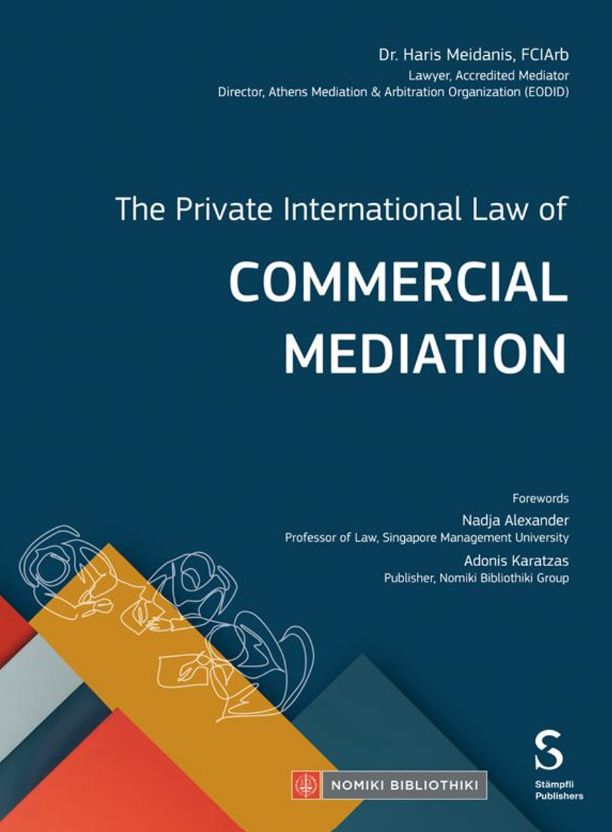
The relationship between private international law and mediation is not apparent. As is well known, mediation is primarily a non-legal dispute resolution method, where emphasis is mostly put on relationships and personal dynamics, not on the application of the law. Interest behind the position is what the mediator is looking for, before they embark on the negotiation stage of the mediation.
The “legal shell” of mediation
However, the law is always there, as a “shell” around mediation, starting from the contract (or the court order, or the law as the case may be) to mediation, the law that governs the process of mediation and eventually the law that governs the agreement after mediation. Indeed, in all the above, some law shall apply. In a domestic setting, this is the law of the country where mediation takes place. But what is the case internationally?
The law in cross-border mediations
In an international dispute having cross-border dimension, the relevant private international law questions are related (a) to the venue (b) to the applicable law and (c) to the enforcement, if needed. These points form the second (special – microview) part of the book).
The first (general -macroview) part is about the way that the international community approaches mediation from a legal point of view. In this context, a general discussion on mediation is done (roots, terminology, non-legal aspects, and then a more focused discussion on the “legal shell”, on mediation and the question of access to Justice, on the “special” character of mediation as a dispute resolution method and on the so-called “hybrid” nature of the MSA, as well as on the legislative initiatives of the international community regarding mediation.
Discussing mediation from a private international law standpoint
As is well known, venue, applicable law and enforcement are the three main subparts of private international law. The position on mediation and private international law is as follows:
Venue. While there is no jurisdiction in mediation, venue can be crucial. First of all, the parties must be happy to travel and spend time at the venue. Secondly, the process rules will most probably differ from country to country (for example the question whether internal confidentiality is the default rule, or the exact opposite unless a party chooses not to disclose). It is important to agree in advance on such rules that do not need to be the ones of the venue (as the venue is not forum), save for any public policy rules that apply there and cannot be contracted out. Thirdly, choosing the venue may also be relevant for the enforcement of the MSA, if ever needed. This question needs to be assessed proactively, also with a view to the choice of venue.
In the book, one can find an extended discussion of all above points, with emphasis on commencement of mediation (contract, compulsory mediation under law or court order), or the mediation process, especially on the conduct and duties of the mediator. In this context, the UNCITRAL model mediation law and rules are extensively presented.
Applicable law. There exist few contracts in a mediation environment, next to the substantive law of the actual contract (if any): (i) The agreement to mediate and the agreement with the mediator. One needs to make sure that the applicable laws in these two agreements do not invalidate any provision of these contracts. (ii) More importantly the MSA. The applicable law to it will bear influence on its enforcement and on any action for its annulment. In the book the method that can be used to define the applicable law in all above contracts is discussed. One can find answers to the problems that may arise in this context, to the extent that such answers are feasible at the present stage of development of mediation.
Enforcement. If a party to the MSA does not perform its obligations under it, the question of enforcement arises. In this context, one can find extensive discussion of the 2019 Singapore Convention on Mediation as well as of the EU systems of enforcement, based on the relevant EU regulations and references to the system oh OHADA. The former has adopted the “direct” enforcement model whereby the place of origin of the MSA is not important (although the term used is “relief”, to mitigate the various legal traditions of the contracting parties of the Convention). What matters is for the state of enforcement to have adopted the Convention. The EU has adopted the “cross-border” enforcement model which means that first an MSA becomes enforceable in a member state of the EU and it can then be enforced in the rest of the EU by virtue of the enforcement regulations of the EU. To be noted here that the fact that the EU has not ratified the Singapore Convention makes enforcement of MSAs from third countries literally impossible in those Member States that do not allow for direct enforcement. Therefore, one needs to examine proactively if such enforcement, either cross-border (in which case the venue matters) or direct, is possible in the country where enforcement may have to take place eventually. To be noted that under certain conditions, the 1958 New York Convention on arbitration can also be used for enforcement.
One important point is that the international community has not worked on all the above issues with equal effort. In fact, the systems of enforcement are the most developed internationally, followed by venue, while applicable law has not stirred the interest of the international community in relation to mediation yet, and in this sense the discussion in the book comes from general applicable law standpoint.
This book can be a valuable assistance to the practitioners of international commercial mediation, both mediators and lawyers and is hoped to initiate a wider discussion of the relevant topics.
.svg)
مركز الابتكار، المستوى 1،
جيت أفينيو - المنطقة الجنوبية
مركز دبي المالي العالمي
دبي، الإمارات العربية المتحدة
info@mediationhub.ae