.svg)
BRIDGING THE ESG GAP WITH MEDIATION PRACTICE

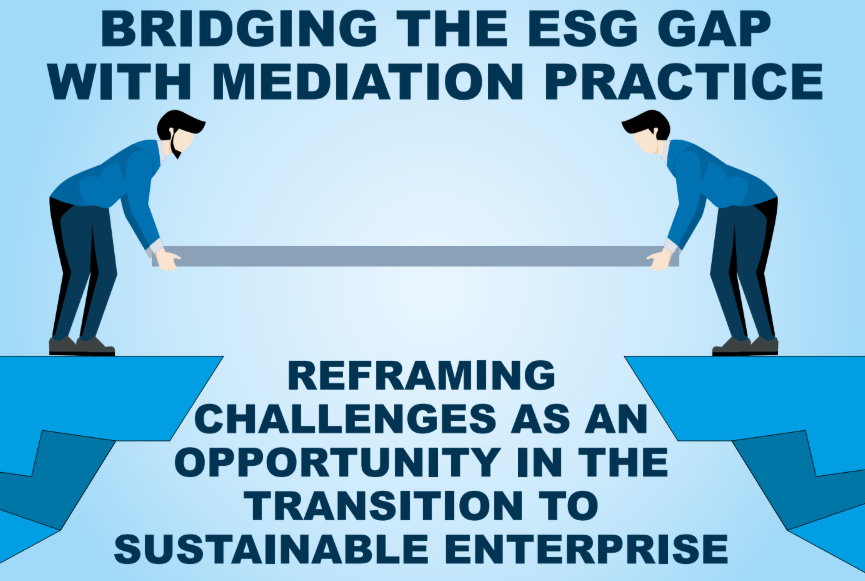
The ESG Gap Is Real And Growing
Over the past decade, Environmental, Social, and Governance (ESG) criteria have evolved from voluntary guidelines into powerful legal frameworks and drivers of corporate behavior. Regulation is intensifying, stakeholder expectations are rising, and civil society is actively engaging in ESG disputes worldwide. Companies face growing pressure not only to prove profitability but also responsibility, with increasing demands for ESG risk metrics from investors and corporate entities. Yet, behind the surge of ESG reports, sustainability strategies, and ethical commitments lies a persistent gap, a growing mismatch between external promises and internal realities. The OECD’s recent report, Behind ESG Ratings: Unpacking Sustainability Metrics, highlights the complexity beneath the numbers.
Many organizations struggle to translate ESG from written policies to authentic practices, from a checklist of commitments to a true “speak-up” culture that delivers real value on the ground. Far from being perceived as an opportunity, this gap is turning into a growing source of disputes, polarizing essential debates around environmental protection and human rights. The ESG gap is not merely technical or legal, it is political, emotional, and operational. It breeds misunderstandings, polarized visions, and conflicts.
Tensions inevitably arise, of multiple nature:
• Between strategy and operations: “We can’t meet these goals and stay competitive.”
• Between generations: “You say climate matters, but your decisions say otherwise.”
• Between departments: “Operations says no; sustainability says yes.”
• Between headquarters and local communities, especially in complex or extractive sectors.
• Between countries and nations.
ESG Tensions Are Structural, Not Incidental
In an era of climate urgency and rapid digital transformation, AI and high-speed technologies amplify societal fractures, reinforce like-minded silos, and often surface behaviors reminiscent of darker chapters in our history.
The ability to listen, facilitate, and co-create is becoming a key competitive and an ethical skill. The ESG agenda naturally creates friction because it pushes organizations to change: to reassess priorities, disrupt routines, and balance competing interests – money versus future generations, money versus equality etc.. It fundamentally challenges the very purpose of business, shifting from pure economic goals to broader, deeper responsibility and purpose, where actions speak louder than words and steps away from immediate rewards.
The Rana Plaza tragedy in 2013 provoked strong reactions worldwide, raising profound ethical questions: does corporate responsibility stop at borders, or does it extend alongside the global reach of products, technologies, and access to critical resources?
France’s pioneering Duty of Vigilance law (Loi n° 2017-39922) imposes obligations on large companies to prevent serious harm to human rights, health, safety, and the environment across their operations and value chains.
European directives now aim at building on this foundation, to extend vigilance obligations across value chains, including non-EU operations, aiming for harmonized sustainability due diligence, although the Omnibus package deal seriously hold back the movement.
The specialized court in Paris’s Pôle, Chambre 12, clarify recently some of the law’s substance application. The June 17, 2025 ruling in La Poste v. Syndicat SUD PTT4 stated that:
• Risk mapping must be precise, not generic.
• Companies are not required to implement detailed measures unilaterally but must co-design effective actions with stakeholders.
• Genuine consultation is mandatory with proven opportunity to elaborate the plan collectively.
• Business secrecy limits disclosure of sensitive data about the value chain, but does not preclude transparency on methodology used and risk mapping Stakeholder engagement and effective grievance mechanisms lie at the heart of duty of vigilance strategy and processes that must be both genuine and participatory on both sides.
What Mediation Offers Beyond Conflict Resolution
Why is mediation suited to a strategic, results-driven approach to ESG challenges?
Mediation is a vital resource in defining and structuring vigilance duties, especially when authentic stakeholders’ engagement and structured dialogue are required. Identifying key stakeholders and managing complex dialogue rounds is challenging for companies, for many reasons, lack of time, distrust, misunderstanding, difficulty to identify interlocutory. This contradicts the viral spread of unverified information, fake news, and hasty judgments that dominate public discourse. Time matters. Mediation procedures are structured and proactive. But they create appropriate timing to process, digest, understand, evaluate information without jumping to conclusion immediately. A neutral third-party expert is a resource to design the process, agenda, timing, priorities and negotiation steps with the parties’ consent and active participation. It is a voluntary process, all along.
As such, mediation can be used as a governance and engagement tool to:
• Surface diverging interests before escalation
• Build trust
• Reframe disagreements
• Enable co-creation beyond win/lose binaries visions
• Provide safe space for internal dissent or community voices
• Reduce litigation risk and reputational harm
This “ESG mediation project” is non- contentious but ensures robust, interest- based, realistic negotiations toward achievable plans with milestones. It relies heavily on William Ury’s four pillars from Getting to Yes book:
1. Be soft on the people, hard on the problem.
2. Focus on interests, not positions.
3. Use objective criteria.
4. Work together for fair and creative solutions.
In contentious matters including Investor-State disputes, the process increasingly relies on conciliation mechanisms (e.g., ICSID, World Bank, OECD Grievance mechanism) to preserve investments and local development, emphasizing the fundamental element of relationships, expectations and needs in the context of financial investments and settlement of disputes. This is never just about money.
Case In Point: Environmental Contamination And Constructive Stakeholder Engagement
A recent confidential case involving long-term environmental contamination, stemming from industrial practices halted 30 years ago and passed through successive owners of the site illustrates these challenges. Successive owners were entrenched in distrust and blame for years, with strong legal postures focused on liability limits. Litigation risk, delay, and reputational damage loomed large. While discussion was ongoing about the potentialities, the actual assessment of the risk was not progressing because, truth be told, no one wanted to spend the money on it.
Legally though, each party held a share, the proportionality could be debated, but this would find no grace to the public opinion. A turning point came when a toxicology report revealed serious potential human health risks. More investigations were needed, and the time to act was now. With the involvement of environmental engineers from both sides, the dynamics changed, the perspective was no more risk-based or legally driven. Negotiations shifted from positional stances to interest-based dialogue. Parties agreed to jointly investigate, clarify risks, implement preventive measures, and remediate jointly the potential damage.
A collaborative stakeholders engagement process emerged, featuring:
• Clear dialogue protocols & steps ensuring confidentiality and equality
• Mutual and equal funding
• Expert vetting and involvement milestones
• Coordinated communication procedures
• Regular adaptive decision-making
• Clear investigation and remediations milestones involving the local authorities
• Transparency
What began as a conflict with potential for prolonged private litigation became a platform for accountability, innovation, and trust-building. The outcome of the investigation/remediation procedures resulted on a 100% risk mitigation for people and the environment around the site. A clear win on every sides. This case demonstrates that mediation is not about evading responsibility, but in long terms issues, where liability allocation is not that obvious, surfacing the issues in a structured manner creates ownership. Resolution begins with how we choose to look at the problem and with involving the right people at the discussion table who can challenge views and bring different perspectives.
No One-Size-Fits-All ESG – The Multicultural Dimension in ESG Mediation
ESG is a global language spoken with diverse accents. What “responsibility” means in Paris differs from Nairobi, Mumbai, or Houston. Culture, history, regulation, and power dynamics shape perceptions of fairness and sustainability. The success of projects involving multicultural parties across different regions depends heavily on the parties’ ability to mutually understand cultural realities from both sides, ethics, and frameworks. Many ESG frameworks assume universality that doesn’t exist. Global companies are caught between conflicting norms and invisible cultural assumptions. Mediation uncovers and works with these differences, not erasing them but honoring pluralism. It questions dominant narratives, recognizes cultural specificity, and finds complementary perspectives. In a fractured world, connection is the most pragmatic and achievable goal we can aim for. Mediation offers this safe space: slowing down, translating expectations and needs, and building bridges.
Conclusion: Don’t Manage ESG Challenge. Mediate It.
The transition to sustainable enterprise is complex and conflictual by nature. But conflict is not failure, it is a signal that a change is needed. Companies that embrace proactive conflict engagement, using mediation, shift from reactive dispute management to shaping shared futures. Mediation offers a human-centered, rigorous path that embodies Humankind: building bridges, where law alone falls short, turning conflict into opportunity.
.svg)
مركز الابتكار، المستوى 1،
جيت أفينيو - المنطقة الجنوبية
مركز دبي المالي العالمي
دبي، الإمارات العربية المتحدة
info@mediationhub.ae